Sunday, 26 January 2014

In response to Muirhead Bone

As part of the Invitation to exhibit at the Royal West of England Academy I have been asked for the piece of work to respond to  works by a war artist. The artist I have been paired with is Muirhead Bone.

http://www.tate.org.uk/art/artists/sir-muirhead-bone-778


 As you can see by the examples above there is a very strong similarity in the aesthetic of his work and my own. We also share the same connection with drawing and the etching process. He had a nickname at the tine as the British Piranesi and the original  Giovanni Battista Piranesi has long been a strong influence on my own work.  
Please see below for examples of Piranesi's Imaginary prison (Carceri d'invenzione) series.


I look forward into seeing how I can look deeper into Muirhead Bones work and hopefully discover more connections and similarities with my own. Within in my own work I want to start looking more into monoliths, monuments and memorials and creating my own form first hand  drawing research and reference. It will be interesting to see how working towards this exhibition can give me more clarity and direction with my own themes and concepts.


Saturday, 18 January 2014

 I have  recently been invited to be a guest Artist for an exhibition at the Royal West of England Academy in Bristol. The show will be in the summer will coincide with the centenary of the beginning of the First world war. I will be working on  new piece of work based on my research on the Maunsell sea forts. I thought I would  document the progress of the work from the initial drawings through to the finished etching. I hope then it will help to serve as an example of how and why I take an image from a drawing through to  finished Print. It is the reasoning and rationale behind this that I question within my own students work and it is important that I am able to realise and understand this within my own work.
Please see the images below for the beginning of this new project.


Fort III - Progress drawing 1.

Fort III - Progress drawing2.
Fort III - Progress drawing3.

Submissions for the Royal Academy Summer show.


After the positive response to my work at the Multiplied Print Fair at Christies, I have decided to enter the following two pieces below for the Royal Academy summer show. 

Fort I - Etching 70cm x 65cm, Edition 20


Transmission - Etching 75cm x70cm, Edition 20


Saturday, 6 July 2013

Larger Charcoal drawings of Sound mirrors

Studio shot of the finished Four larger drawings- Roughly A1 in size


Now the larger drawings are finished I will need to start breaking them down and editing the information to be included in the final etchings. This suite if etchings will then be exhibited for the first time in October at Multiplied art fair, 2013 hosted by Christies auction house, London.

Friday, 28 June 2013

Fresh Inspiration - Sound Mirrors - Denge, Dungeness, Kent

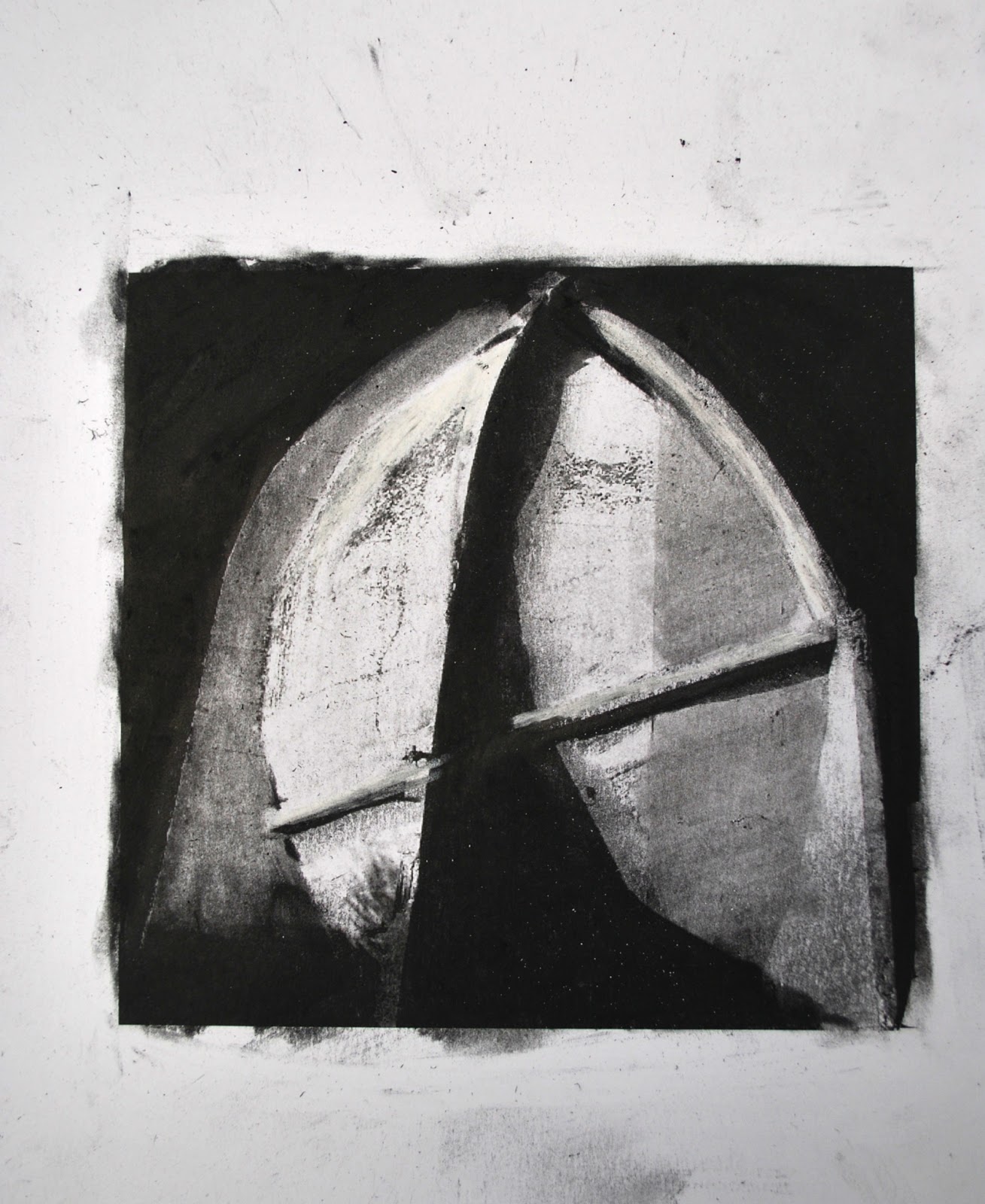
1. Sound mirror, charcoal


2. Sound mirror, charcoal

3. Sound mirror, charcoal

4. Sound mirror, charcoal

 The quick charcoal  studies above are of the sound mirrors based in Kent. (For more information please see below). I plan to complete a series of drawings and then take a selected few and rework them through the etching process. Two or three larger charcoal drawings will be completed next week to start to understand the tone and form of the mirrors. The images will then start to take on a life of their own and  inform how I can use line, aquatint and mark making for a final print.


Information on The sound mirrors;

Prior to World War II and the invention of radar, acoustic mirrors were built as early warning devices around the coasts of Great Britain, with the aim of detecting incoming enemy aircraft by the sound of their engines. The most famous of these devices still stand at Denge on the Dungeness peninsula and at Hythe in Kent. 
The Dungeness mirrors consist of three large concrete reflectors built in the 1920s–1930s. Their experimental nature is evident by the different shapes of each of the three reflectors: one is a long, curved wall about 5 m high by 70 m long, while the other two are dish-shaped constructions approximately 4–5 m in diameter.

The mirrors fit well with my interest in man made objects and forms. An increasing area of interest is also how the technology that was cutting edge soon becomes defunct and redundant and super seeded by something else.